
Subject: Vastness in Tiny Things
Perhaps it is only a mythical topography, but I have always been hazardously close to sentimentality towards the landscape of 19th century travelogue literature. In it, the world is vast and you (white, male, inordinately wealthy, implied) have only to step out of your comfort zone and bam!—Discoveries abound (just waiting to take your name (possession is so easily substituted for love)). So much is unknown but it is not unknowable.
Is it trite to compare a past mostly constructed from romantic half-truths to the world today? Even more specifically, my experience of the world? Almost certainly, yes. That past where forests, bison, reefs were all infinite, inexhaustible, uncontainable is the same past where colonizers—all hopped up on the feelings that vastness inspires—began destroying them. Now forests, bison, reefs are countable, dwindling, and the world feels all too small. We know of 4,800 species of frogs but mostly what we know about them is that they're disappearing, which is just a nice way of saying horrific death on a large scale.
I didn't mean to go so quickly into a depressing tangent, I just wanted to talk about why the world feels small. But our interior geography is a translation of the external, and the terra incognita of our collective imaginings is bounded by the amount of mystery and unknown we perceive around us. All of this is, somehow, my way of recommending an article about the Olive Garden.
Two roads diverged in a yellow wood and I—rather than just tell you about this article—chose a meandering digression through deforestation. What I want to convey, though, apart from the idea that everything is falling apart and the world is dying and our souls are withered husks and I regret how deeply colonialist literature informed my youthful daydreams, is that before, when the world felt big and unknown and full of mystery, a writer's (or artist's) job was often to tell people who weren't there what they would have seen. In 15th century Europe, a drawing of an elephant that looked like it was drawn by a 4th grader could go viral and just seeing it would give your whole town weeks of fodder for discussion and speculation.
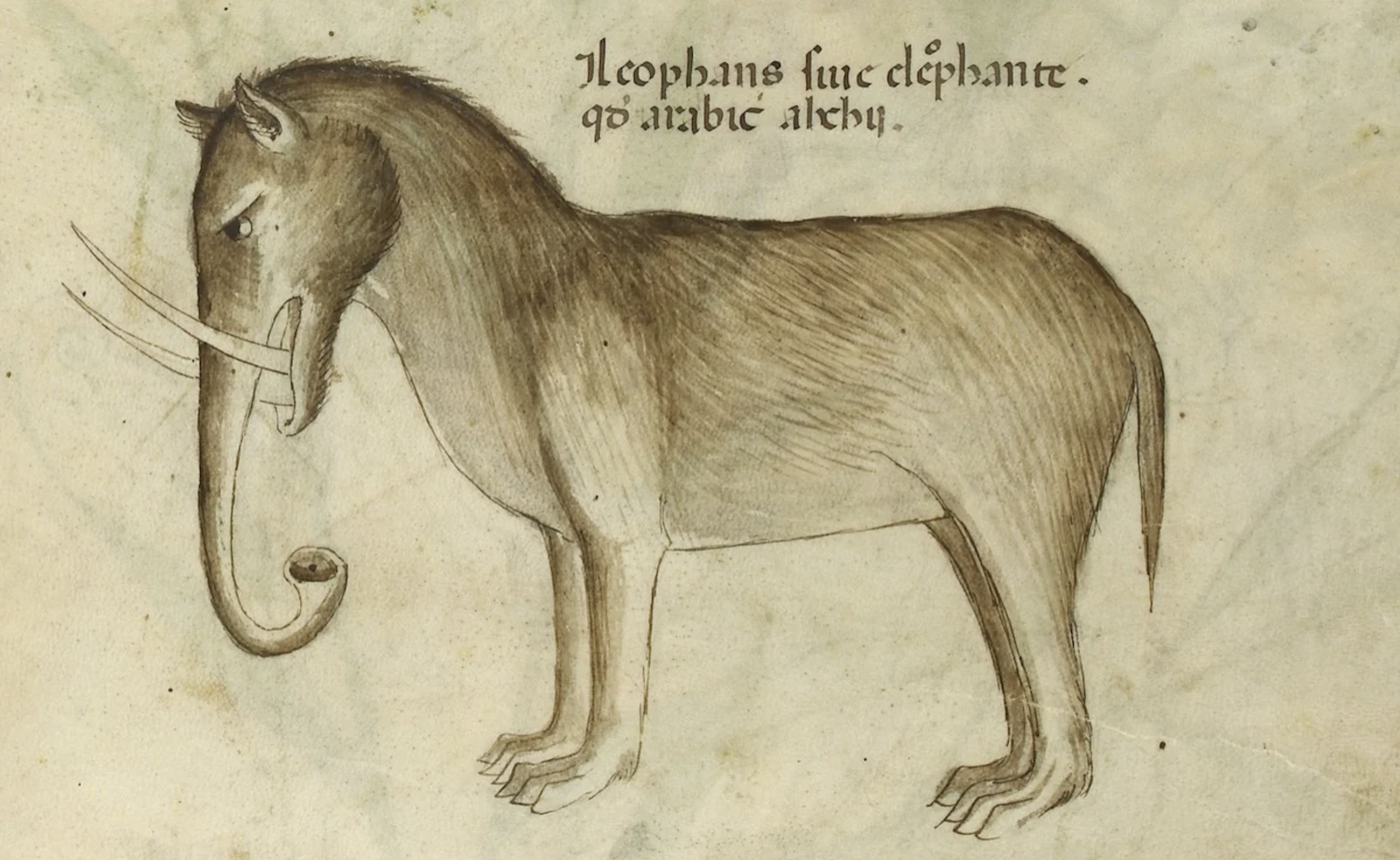
15th Century Illustration of an Elephant
Because we now have so much access to information, the purpose of writing hasn't changed, but the role of the writer has. Which is, to bring this whole thing back around, why I am recommending an article about the Olive Garden. It highlights what I think modern writing is supposed to do. It's a process of embiggening our ((compressed)) world. We know about fish in the deep seas wilder and less imaginable than nightmare beasts, and yet I often feel jaded, as if there is nothing left to know. When the pools of mystery dry up, so goes magic, and with it, wonder.
But then take the Olive Garden, something so mundane as to be unremarkable. If I saw three Olive Gardens on the same block, I'm not sure I'd notice. Having eaten there 3-4 times in childhood, I assume I already know everything worth knowing about the place. Then along comes Helen Rosner with somehow 4,600 words to say on the subject (only slightly fewer than known species of frogs) and I am forced not just to reconsider the Olive Garden but everything else. Because if something so dull as America's most mediocre chain can be so interesting, what other secrets are disguised by a veneer of banality?
This is the key. If once the job of a writer was to tell people who weren't there what they would have seen, now a writer has to find a way to tell people who were there what they didn't see. All you have to do is find magic in a potato, or a George Foreman grill, and you realize: there is as much mystery and magic in the world as there has ever been. Mystery is inexhaustible even if our perception of it is not. The scarcity of mystery is a postcolonial deception. Through this lens, the world expands, and there is space among the wild, dark canyons in our deep imaginings to love the unknowable without containing or possessing.
Recommended Reading: Christ in the Garden of Endless Breadsticks
I guess this was my takeaway from an Olive Garden review? 🤷♂️Feel free to lmk what you think in a hot 🔥🔥🔥 letter to the editor: nome@nome.land
🦎 Ask a Gecko 🦎
Dear Gecko,
I have been thinking about buying a new vehicle, but I'm having trouble deciding between a gas-efficient hybrid or a really cool truck. On one hand, I know it's important (and economical) to maximize fuel efficiency. On the other, I could use the truck to help my friends move stuff and I would also look very attractive driving it. How can I make up my mind???
- Having Unnecessary Mental Anguish Now
Dear HUMAN,
The gecko blinks slowly, then quickly licks his eyeball with his little pink tongue. He takes a few serpentine steps forward in almost agonizing slow-motion, and looks at you directly. His smile is dopey, unreasonably like Kermit the frog. He flattens himself against a stone and is still for as long as you can tell. He is currently digesting a mealworm.